

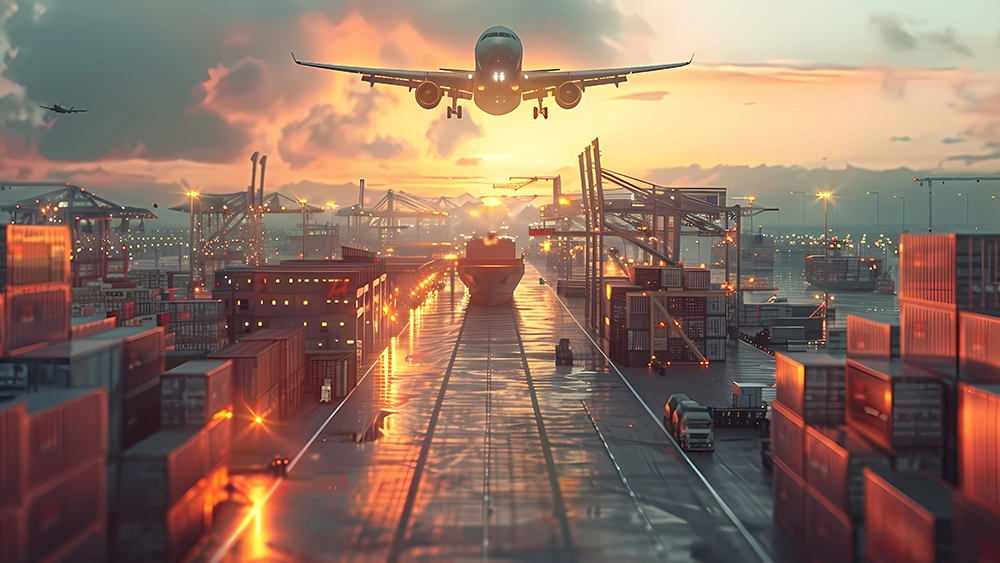
1.What Is Air Freight
Air freight is the fastest and most reliable form of international transport, used for high-value, time-sensitive, or perishable goods.
While the cost per kilogram is higher compared to sea or road transport, air delivery minimizes storage time, reduces risks of damage, and ensures predictable lead times.
Air shipments are regulated by the International Air Transport Association (IATA) and the International Civil Aviation Organization (ICAO), with standardized documentation and safety protocols applied worldwide.
2.What Cannot Be Transported by Air
Certain goods are strictly prohibited from being carried on commercial aircraft due to safety, security, or legal restrictions.
⚠️ Each airline maintains its own “Dangerous Goods List,” which must be verified before booking.
Certain restricted items may still be shipped under IATA Dangerous Goods Regulations (DGR) if properly packaged, labeled, and declared.
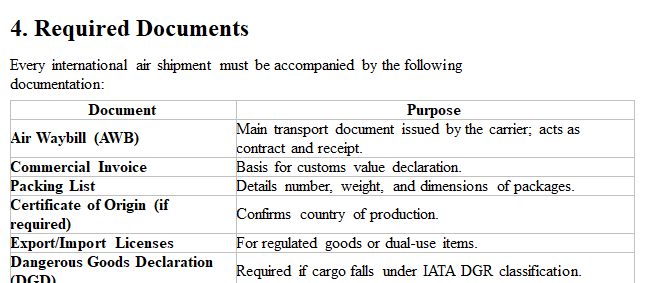
3.Cargo Parameters for Air Transport
Air transport has strict limitations on size, weight, and packaging:
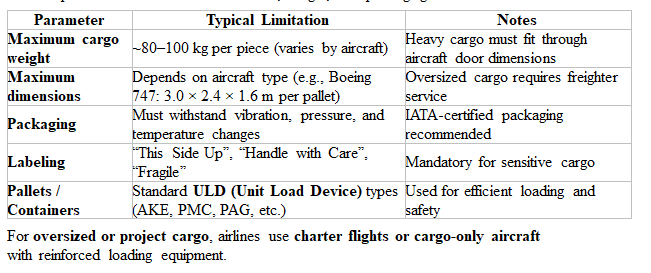
4.Required Documents
Every international air shipment must be accompanied by the following documentation:
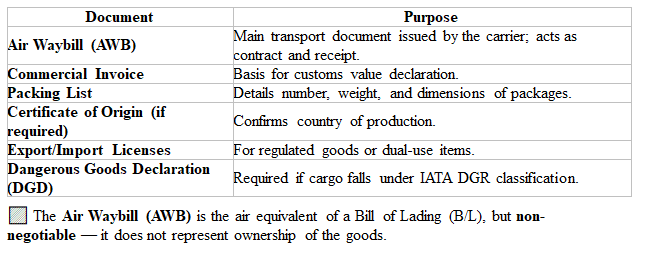
5.Special Handling Categories
Some goods require additional documentation and handling:
Perishable goods (PER): temperature-controlled packaging, time-critical routing
Valuable cargo (VAL): jewelry, electronics, confidential documents — requires secure storage
Live animals (AVI): transport according to IATA Live Animals Regulations
Human remains (HUM): special procedures and consular documents
Dangerous goods (DGR): classification, labeling, and shipper’s declaration required
6.Advantages of Air Freight
✈️ Speed — delivery from Europe to Asia within 1–3 days.
📦 Reliability — precise schedules, minimal risk of delay.
🔒 Security — strict airport control reduces theft and damage.
🌍 Global reach — even remote destinations accessible via air hubs.
📈 Lower inventory costs — shorter lead times mean fewer goods in storage.
💡 Coming next:
“Digital Budgeting Systems: Choosing the Right Platform for Financial Control and Implementation.”
7.Disadvantages
💶 High cost per kilogram — 5–10 times more expensive than sea freight.
📏 Limited volume and weight capacity — unsuitable for bulk cargo.
🧾 Complex documentation — DGR and customs paperwork can be time-consuming.
🌱 Environmental impact — highest CO₂ emissions among transport modes.
8.Practical Recommendations
✅ Check with your freight forwarder which goods require IATA DGR certification.
✅ Always confirm cargo dimensions and aircraft door size before booking.
✅ Use approved packaging — avoid wooden crates without ISPM-15 treatment.
✅ Mark gross weight and airport codes (e.g., FRA → DXB) on each package.
✅ For high-value or sensitive goods, insure the shipment and request GPS tracking.
Conclusion
Air freight offers speed, precision, and reliability unmatched by other transport modes — but demands attention to detail.
Understanding restrictions, cargo limitations, and documentation requirements ensures smooth customs clearance and safe delivery.
In professional logistics, success often depends on knowing not just how to move cargo — but how to move it right.
