

What Are Incoterms?
Incoterms (International Commercial Terms) are a globally recognized set of rules developed by the International Chamber of Commerce (ICC).
They define the responsibilities of buyers and sellers in international trade — who arranges transport, who pays for insurance, and at what point the risk transfers from one party to another.
First introduced in 1936, the latest edition Incoterms 2020 remains the foundation for all international logistics contracts.
2.Why They Matter
Define the boundary of responsibility between seller and buyer
Determine who pays for freight, insurance, and customs duties
Affect risk, tax obligations, and delivery timing
Help avoid disputes in cross-border operations
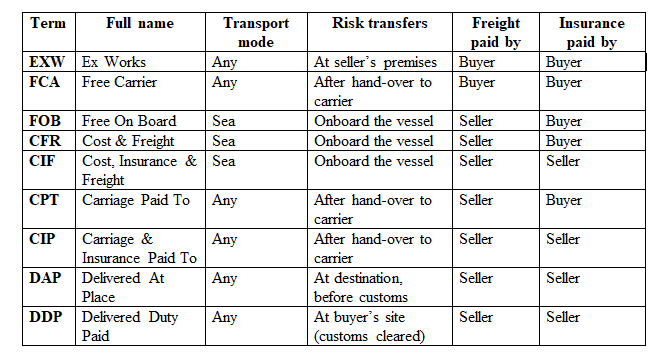
3.Incoterms 2020 Summary Table
4.How to Choose the Right Terms
Key Criteria:
Type of Transport
Sea freight → FOB, CFR, CIF
Air / road freight → FCA, CPT, CIP
Multimodal routes → DAP, DDP
Level of Control
If you have a strong in-house logistics team — choose EXW / FCA to stay in control.
If you trust your supplier and value time — DAP / DDP shifts the logistics and risk to them.
Risk & Insurance
FOB / FCA — risk passes once goods are handed to the carrier.
CIF / CIP — the seller must provide cargo insurance.
DDP — seller bears all costs and risks until delivery.
Tax & Customs
Choice of Incoterm affects VAT, import duties, and currency control.
Always align the delivery terms with your fiscal and legal framework.
5.Expert Recommendations
For complex international projects with multiple participants — prefer FCA or CIP for transparent settlements.
Avoid EXW when exporting from countries with strict currency or export controls.
Use DDP only if you have a local entity in the buyer’s country.
Always specify exact delivery points and responsibilities in writing — ports, terminals, and customs zones.
6.Before You Sign the Contract
Before finalizing delivery terms, take a pause and ask yourself a few key questions:
Who do you trust with the logistics?
If you want things done right — do it yourself.
If you have a reliable and proven partner, you can transfer the delivery responsibility and associated risks to them.
If this is your first cooperation with a new supplier, keep delivery control in your hands — at least for the first project.
Do both parties understand the same thing by “FOB” or “CIF”?
During international negotiations, people think and speak in different languages — literally and legally.
Always spell out the Incoterm in the contract (e.g., “FOB — Free On Board, Port of Hamburg, Germany — Incoterms 2020”).
A few extra lines in the contract can save weeks of dispute resolution later.
Are you entering a new market?
Don’t bring your rules into someone else’s system — learn the local business practices and delivery norms in that region.
Customs, documentation, and even interpretations of Incoterms may vary from Europe to Asia or Latin America.
Have you talked to your auditor and customs broker?
Before signing, consult your auditor to ensure that the selected Incoterms will be reflected correctly in your accounting and tax records.
Seek advice from a customs broker — properly chosen delivery terms often save not only on logistics costs but also on customs clearance expenses.
Conclusion
Incoterms are not just abbreviations — they define the entire logic of an international project.
The right choice determines how smoothly your cargo travels, how costs are distributed, and how quickly issues are resolved.
Understanding and applying them wisely means protecting your interests long before the shipment even leaves the factory.
