

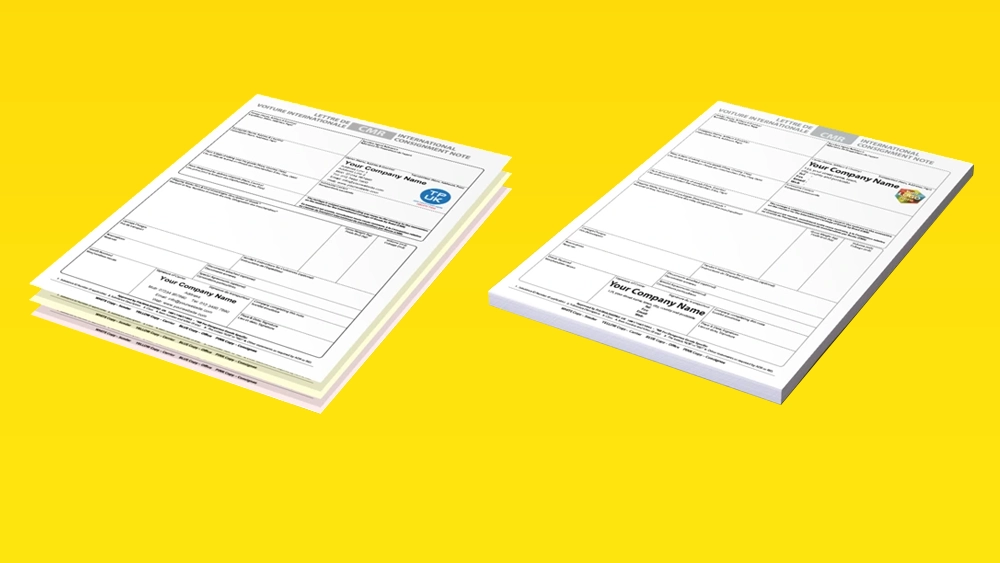
1.What is a CMR?
The CMR Consignment Note (Convention relative au contrat de transport international de marchandises par route) is the official international transport document confirming the contract of carriage for goods moved by road across borders.
It’s used in nearly all European and CIS countries under the 1956 CMR Convention and serves as both:
proof of the transport contract,
and a receipt confirming that the carrier has accepted the goods.
Without a properly completed CMR, customs clearance, insurance claims, or payment verification may become problematic.
2.The Structure of the CMR Form
The CMR is usually printed in four copies:
Red – for the sender (consignor)
Blue – for the receiver (consignee)
Green – for the carrier (driver/transport company)
Black – for administrative and customs purposes
Each copy must be signed and stamped where applicable.
3.How to Fill Out the CMR — Line by Line
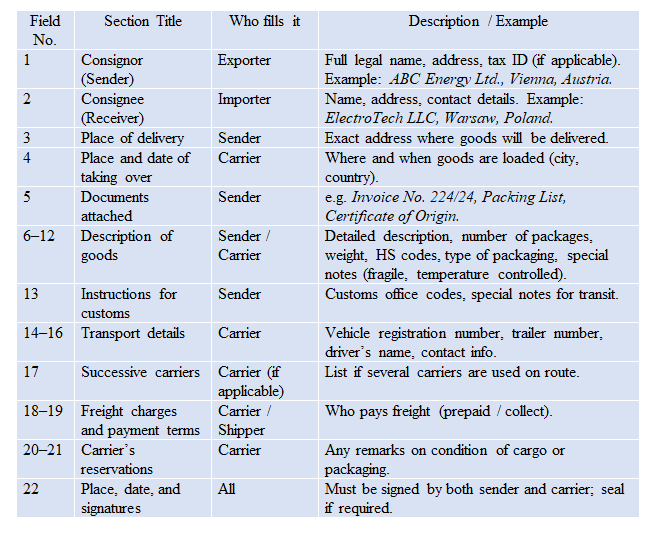
4.Key Rules and Recommendations
✅ Write clearly and consistently. Use block letters in English (or bilingual version: English + local language).
✅ No empty fields. If a section is not applicable, write “N/A” — otherwise customs may interpret it as missing data.
✅ Match documents. Information in the CMR must match the invoice, packing list, and export declaration exactly.
✅ Signatures matter. A missing signature can invalidate the document for insurance or claims.
✅ Driver’s section. The carrier must indicate the vehicle number, date, and signature before departure.
✅ Weight and packaging. Specify gross weight (kg) and number of packages/pallets. Do not use vague terms like “1 lot.”
✅ Corrections. If an error occurs — cross it out neatly, write the correct data, and have it re-signed by both parties.
5.Typical Errors to Avoid
🚫 Inconsistent consignee name between CMR and invoice
🚫 Missing customs office details (for T1/TIR routes)
🚫 Using only a company name without a full address
🚫 Leaving the “freight payment” box blank (especially for DAP/DDP terms)
🚫 Forgetting the driver’s signature or vehicle plate number
6.Example Layout (Visual Guide)
| 1. Consignor: ABC Energy GmbH, Vienna, AT |
| 2. Consignee: EnergoTech Sp. z o.o., Warsaw, PL |
| 3. Place of delivery: Warsaw, PL |
| 4. Date of loading: 09.10.2025, Linz, AT |
| 5. Attached documents: Invoice #2025-088, Packing List |
| 6–12. Goods: Transformers, 4 pallets, 3,200 kg, HS 8504 |
| 14. Vehicle: W123XYZ / Driver: Ivan Petrov |
| 18. Freight: Prepaid |
| 22. Signatures: |
| Sender _ Carrier _|
7.Before Filling the CMR
Before the driver signs the CMR and the cargo leaves the warehouse, make sure you’ve checked the following:
Documents Prepared
Invoice, packing list, and export declaration match the cargo exactly.
Customs codes (HS) and Incoterms are the same in all documents.
Contract Terms Aligned
The delivery terms (Incoterms) are reflected properly in the CMR — for example, “FCA Hamburg” or “DAP Warsaw.”
Freight payment (prepaid or collect) corresponds to the contract.
Carrier and Vehicle Details Verified
Check the transport company license, vehicle plate numbers, and driver’s ID.
Confirm that the carrier understands the route, border crossings, and required transit documents (T1, TIR, etc.).
Insurance and Risk Coverage
Ensure that cargo insurance is issued and number is referenced in the CMR (Field 5).
If you work under FCA/EXW, confirm that your buyer’s carrier is insured.
Signatures and Stamps
Both sender and carrier must sign all copies of the CMR.
Avoid using scanned signatures — only originals are valid
Conclusion
A correctly filled CMR is not just a formality — it’s your legal protection in international logistics.
It proves delivery, defines risk transfer, and supports both customs and accounting accuracy.
Attention to these details will save time, money, and reputation when it matters most.
